

Mid-Project Report: University of Stuttgart
EffiTorch – Efficient valorisation of CO2 and bio-waste
EffiTorch aims at developing an alternative breakthrough technology for Power-to-X based on the direct splitting of CO2, using an ultra-high temperature thermal plasma, with the simultaneous valorisation of low value bio-waste, leading to the efficient production of syngas.
Specific Objectives
Development of a CO2 and bio-waste valorisation process based on the use of a MW plasma torch and rapid quenching of the plasma.
USTUTT will develop a process for the valorisation of CO2 and bio-oil using their MW torch with cylindrical resonant cavity, ultrasonic atomizers for the bio-oil and a high temperature reactor.
Mid-Project Findings
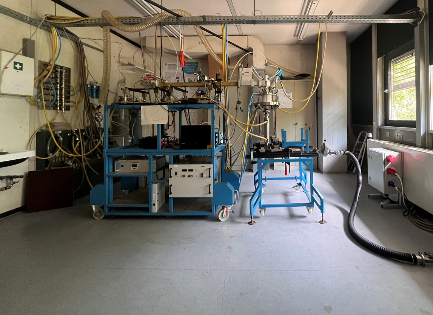
At the laboratories of the partner USTUTT, a laboratory was set up for EffiTorch, complete with infrastructure such as power, cooling water, and compressed air supplies, as well as exhaust gas disposal, room ventilation, and safety systems.
At the same time, the EffiTorch experiment was assembled using existing system components.
The measurement equipment was installed and tested for recording process parameters, diagnosing the plasma, and analyzing the product gas.
Due to delays with the high-temperature reactor from partner Tekniker, preliminary investigations were initiated using a temporary tubular reactor. The pure CO2 plasmas were characterized, and the conversion rate of 8.5% and energy efficiency of 22.5% were determined.
To test how the effluent CO2 plasma reacts with a test oil, a crucible was placed in the temporary tubular reactor. The partner Tekniker specified ethyl caprate (C12H24O2) as the test oil. It was found that the reaction proceeds spontaneously and completely. Initial analyses showed that a large proportion of syngas can be produced.
Upon the arrival and setup of the high-temperature reactor with an atomizer for the bio-oil, CO2 conversion was first verified, followed by an analysis of the atomization pattern. The atomizer’s spray pattern was analyzed using a high-speed camera. Distilled water was used for the initial in-depth analyses of the ultrasonic system’s operation. A upper limit of 5 ml·min-1 was determined for reliable operation. This was subsequently confirmed for the test oil, ethyl caprate.
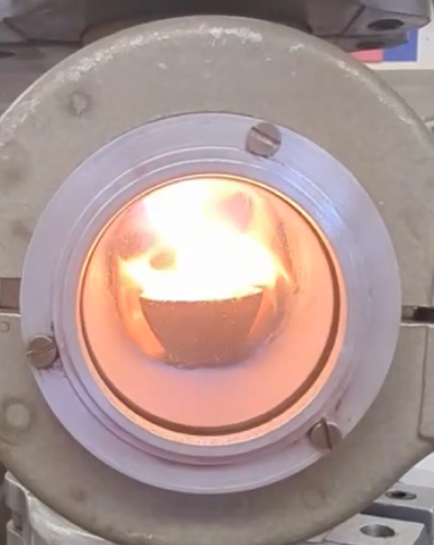
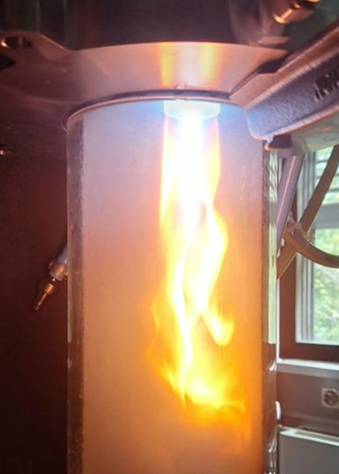
For the initial experiments with CO₂ plasma and test oil, the wall of the high-temperature reactor was replaced with a quartz glass tube. This allowed for direct observation of the dynamics of the interaction between the effluent CO₂ plasma and the test oil, as well as the conversion process.
USTUTT:
Institute of Interfacial Process Engineering and Plasma Technology (IGVP), University of Stuttgart
Mid-Project Result
As an interim finding, it can be concluded that the EffiTorch conversion process proceeds smoothly in the high-temperature reactor.